Leave Your Message

7 Outdoor Chaise Lounge Buying Tips for Global Buyers?

Choosing an Outdoor Chaise Lounge for an international project involves more than comparing prices and photographs. Buyers must consider climate, intended use, available space, and the practical details of sourcing across borders. A frame that performs well on a sheltered patio may need different care beside a pool or in a humid coastal setting. Small details matter.

Start with the setting. Measure the area, including space for reclining and walking around the lounger. Check whether the backrest adjusts easily and whether the seat feels supportive in more than one position. Materials deserve equal attention: aluminum, teak, resin wicker, and outdoor fabrics each have different maintenance needs. Ask suppliers about finishes, UV resistance, drainage, and replacement parts. Request specifications and product images from several angles. A polished photo alone proves little.

For global buyers, the purchase also includes packaging, delivery timing, assembly, and communication with the supplier. Confirm dimensions, carton details, care instructions, and what is included before comparing quotations. Test a sample when possible. It may reveal a loose joint or a fabric color that looks different in daylight. There is no universal best choice; budgets, weather, and design priorities vary. Even careful checks cannot remove every uncertainty, and that is worth admitting. The following seven tips offer a practical way to assess options, ask clearer questions, and choose an Outdoor Chaise Lounge suited to its real setting—not just the product listing.
7 Outdoor Chaise Lounge Buying Tips for Global Buyers?

Understanding Outdoor Chaise Lounge Types and Uses

7 Outdoor Chaise Lounge Buying Tips for Global Buyers?

Understanding Outdoor Chaise Lounge Types and Uses

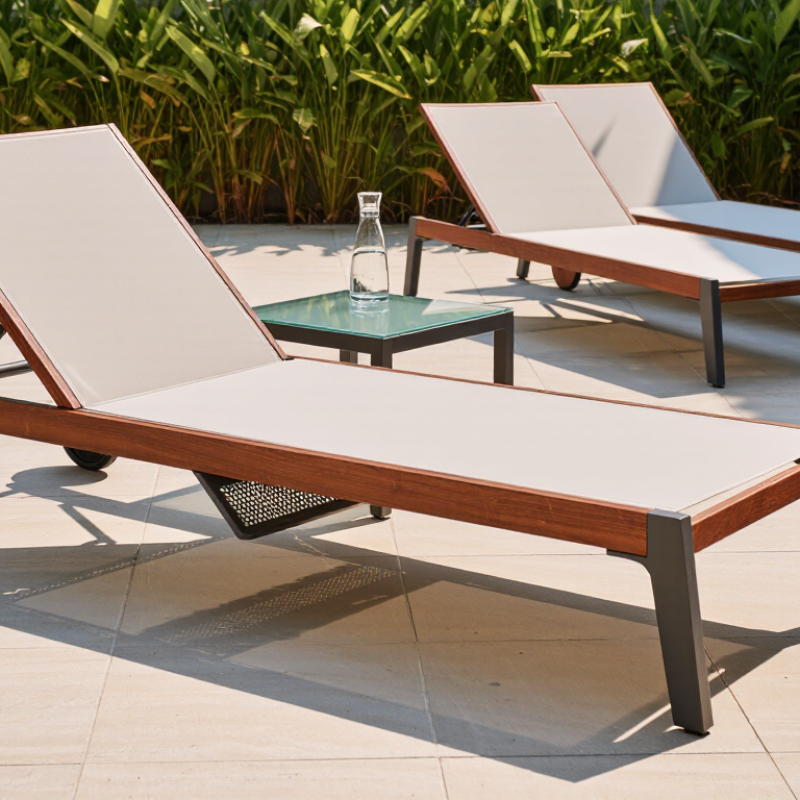
An outdoor chaise lounge is not one universal product. Its frame, back adjustment, and portability should match how people will use it. Fixed loungers suit hotel decks and stable patios where furniture can stay in place. Adjustable-back models work better for reading, sunbathing, or sitting upright beside a pool. Small detail, big difference.

Folding designs are useful for balconies, seasonal venues, and buyers with limited storage. Wheeled loungers can move across broad terraces, though wheels may struggle on gravel or soft lawns. Stackable models help hospitality teams clear space quickly. Test the stack height and weight with staff if possible. A catalog photo rarely shows the awkward part.

Climate matters as much as style. In humid or coastal settings, check drainage, corrosion-resistant hardware, and fabric drying time. For strong sun, ask about UV resistance and replaceable sling fabric; colors can fade sooner than expected. Poolside use calls for easy-clean surfaces and stable feet on wet paving. For a garden, wider frames may feel more relaxed, but they take up more room. I would not choose by cushion thickness alone: trapped moisture can make a plush seat uncomfortable after rain. Consider who will move, clean, and store each piece. This is often overlooked.
Choosing Materials for Climate and Long-Term Durability

Climate should guide material choice before color or price. The World Meteorological Organization’s State of the Global Climate 2024 report puts that year’s global average temperature about 1.55°C above the 1850–1900 average. This figure cannot predict conditions on your patio, but it highlights why local heat, rain, and sun exposure matter. Salt air matters.

For wooden frames, check drainage, sealed end grain, and the maker’s maintenance instructions. The USDA Forest Products Laboratory’s Wood Handbook notes that wood’s moisture content responds to surrounding humidity; at about 21°C and 65% relative humidity, equilibrium moisture content is roughly 12%. Repeated wetting and drying can stress joints and finishes. This is easy to overlook. A beautiful finish can still need regular care.

For coastal or humid settings, inspect metal-frame coatings for chips and ask what corrosion testing supports the stated performance. For sling fabric and cushions, request UV-resistance test results and confirm whether covers can be removed and cleaned. ASTM G154 describes accelerated UV exposure testing, but lab hours do not translate directly into years outdoors. Shade helps. I’d compare test methods, not just durability claims, and consider how quickly each material dries after a storm.

Outdoor Chaise Lounge Materials: Thermal Expansion in Hot and Cold Climates

Typical linear thermal expansion coefficients show how much a material changes length as temperature changes. Higher expansion can mean more movement in outdoor heat, so allow for movement in joints and fasteners.

Approximate typical values: aluminum 23.1, 304 stainless steel 17.3, and HDPE about 150 µm/m·°C. Actual values vary by alloy, grade, and product formulation.

Checking Size, Comfort, Adjustability, and Weight Capacity

Measure the chaise lounge in its fully extended position, not just as a compact frame in a product photo. Compare its length and width with your patio, balcony, or poolside walkway. Leave room to walk past it and adjust the backrest. Measure twice. Buyers ordering internationally should check whether dimensions are listed in centimetres or inches; a small conversion error can make a tight space unusable.

Comfort is personal, so look beyond cushion thickness. Check seat depth, back support, fabric feel, and whether the surface stays comfortable against bare skin. If possible, try a similar chair for ten minutes. Notice whether your knees feel supported and your shoulders can relax. I have found that a soft cushion can look inviting but feel too low after a short rest. Product photos rarely show that clearly.

Adjustability matters when you read, nap, or sit upright. Check how many recline positions the lounge offers and whether the locking mechanism feels steady. For weight capacity, use the stated limit as a firm specification, not a rough suggestion. Compare it with the expected user’s weight and check whether the rating applies to one person or shared use. Small details matter. Also inspect the frame joints and support slats; a high capacity figure means little if the structure feels unstable. Be willing to reconsider a choice if the measurements or rating are unclear.

Comparing Safety Standards, Warranty, and Supplier Reliability

When comparing outdoor chaise lounges, check safety evidence before comparing finishes. EN 581-1 sets general safety requirements for outdoor furniture, while EN 581-2 covers seating strength and stability tests. Ask for test reports matching the exact frame, fabric, and reclining mechanism you plan to order. A certificate for a similar model is not enough. Small details matter.

Supplier reliability deserves equal scrutiny. Grand View Research valued the global outdoor furniture market at USD 50.01 billion in 2023 and forecast 5.6% annual growth from 2024 to 2030. That expansion creates more options, but it does not prove a supplier can maintain consistent quality. Request the written warranty, including exclusions for corrosion, fabric fading, and cushion damage. Confirm whether replacement parts remain available after the first shipment. Check production capacity, inspection records, and how quickly the supplier resolves defects. A polished catalog is reassuring, but it cannot replace batch-level test documents. I would still verify these details independently; paperwork can look complete while leaving practical gaps.

Planning Shipping, Assembly, and After-Sales Support

For global buyers, shipping a chaise lounge is not just a freight quote. UNCTAD’s Review of Maritime Transport 2024 reports that over 80% of world merchandise trade by volume moves by sea, so port congestion and inland delivery can affect arrival dates. Ask suppliers for packed dimensions, gross weight, carton count, and estimated transit time. Confirm who handles customs clearance, duties, and final delivery before placing an order. A large carton may fit a container but still be awkward to move through a narrow doorway. Measure the delivery route, not only the patio.

Assembly should be clear before the cartons arrive. Request a parts list, labeled hardware, and a short assembly guide; check whether two people and basic tools are needed. The World Bank’s 2023 Logistics Performance Index compares 139 economies across areas including tracking, logistics competence, and timeliness. Use those factors to assess the delivery plan, while remembering that a strong national score cannot guarantee a smooth last mile. Small parts matter. After-sales support deserves the same scrutiny: ask how replacement slats, bolts, or fabric parts are ordered, and how long they remain available. Get warranty coverage and response times in writing. A missing washer is minor, until support takes weeks. I would also leave room for uncertainty: packaging can arrive scuffed, and assembly instructions are not always perfect.

7 Outdoor Chaise Lounge Buying Tips for Global Buyers: Planning Shipping, Assembly, and After-Sales Support
No. Planning Area What to Check Before Ordering Practical Buying Tip Information to Confirm in Writing
1 Outdoor suitability Check the frame material, finish, fabric composition, UV-care guidance, and drainage or drying instructions. Match the product to its intended setting, such as a covered patio, poolside area, or fully exposed garden. Ask how routine cleaning and storage affect the materials. Material specifications, care instructions, intended-use guidance, and any stated warranty exclusions for weather exposure.
2 Dimensions and fit Review the assembled length, width, height, seat height, recline positions, and package dimensions. Measure the placement area and access route, including gates, lifts, stairways, and doorways. Allow room to recline and move around the lounge. Product and carton dimensions, net and gross weight, and whether cushions or accessories ship separately.
3 Shipping method and cost Compare available freight options, shipment size and weight, delivery address requirements, and quoted transit estimates. Request a complete landed-cost estimate. Freight, insurance, customs duties, taxes, and destination handling charges may be priced separately and vary by route and country. Shipping term and named place, included charges, estimated dispatch and transit windows, delivery scope, and responsibility for import clearance.
4 Packaging and transit protection Ask how the frame, moving parts, finish, and cushions are protected and whether cartons are suitable for the planned transport mode. For a large or multi-unit order, request carton details and photographs of the packed product. Confirm whether packaging can be recycled or disposed of locally. Number of cartons per unit, package weights and dimensions, packaging materials, and the process for reporting transit damage.
5 Assembly requirements Check whether the lounge arrives assembled or flat-packed, which tools are needed, and whether fixings are included. Review the assembly guide before purchase, especially for multi-unit installations. Confirm that instructions use clear diagrams and identify parts and fasteners. Assembly steps, required tools, included hardware, estimated assembly time if provided by the seller, and access to replacement fasteners.
6 Delivery and receiving Confirm whether delivery is to the curb, building entrance, or a specified room, and whether appointment scheduling is available. Arrange help and equipment for unloading if needed. Inspect cartons at receipt and record visible damage before signing, following the carrier’s local procedures. Delivery service level, appointment and access requirements, unloading responsibility, proof-of-delivery process, and claim deadlines.
7 After-sales support Check the warranty period and coverage, service contact options, spare-part availability, and support for buyers in the destination country. Ask how to submit a claim and what evidence is required. Keep the invoice, order details, assembly instructions, and photographs of any issue. Warranty terms, exclusions, claim procedure, response channel, spare-parts policy, and who pays shipping for approved replacement parts.