Why Choose Aluminium Garden Furniture for Your Business?
For hotels, cafés, garden centres, and rental venues, outdoor furniture is not merely decoration. It must handle daily use, changing weather, and the occasional scrape from a moving chair. Aluminium Garden Furniture appeals because it is relatively light, resists rust, and is easy to rearrange. That can make seasonal layouts simpler for staff. It is not indestructible, though. Thin frames, loose fasteners, and poor finishes can disappoint buyers quickly.
The commercial opportunity sits within a growing category. Grand View Research valued the global outdoor furniture market at about US$50.94 billion in 2023 and projected 5.9% annual growth from 2024 to 2030. This figure covers outdoor furniture overall, not aluminium alone, so it should not be mistaken for an aluminium-specific forecast. Materials scientist Michael F. Ashby’s materials-selection framework offers a useful principle: match a material to its service conditions, not just its appearance. For a business, that means checking frame thickness, coating quality, load capacity, warranty terms, and replacement-part availability before ordering. Small details matter.
A chair that stacks neatly can save storage space; a finish that scratches easily can add maintenance work. The right choice depends on climate, usage, and budget. There is no perfect set. A careful comparison can help businesses balance durability, appearance, and operating costs.
What Aluminium Garden Furniture Is
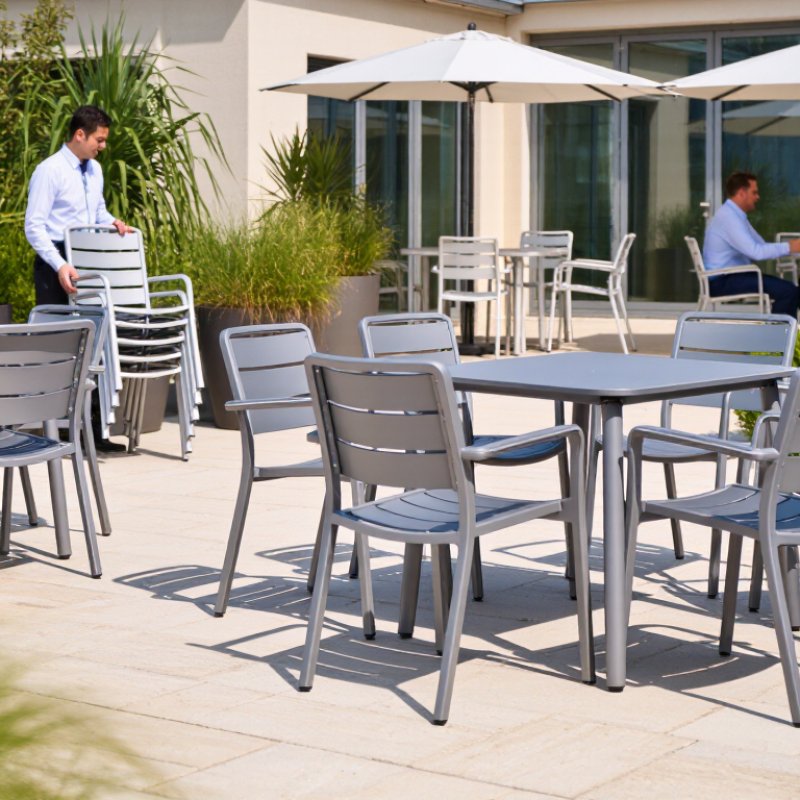
Aluminium garden furniture is outdoor seating or dining furniture built around an aluminium frame. The frame may use hollow extruded tubes, cast joints, or a mix of both. Designers choose aluminium partly because it is light enough to move between a patio and a storage area, yet can be engineered for everyday use. Light, but not flimsy. Wall thickness, joint design, and fasteners still matter; a thin frame with weak connections can wobble.
Many pieces have a powder-coated finish, which adds colour and helps shield the surface from wear. Aluminium naturally forms a thin oxide layer, but coastal salt and trapped moisture can still cause pitting over time. Rinse off salt, check joints, and avoid leaving cushions wet against the frame. Small details matter.
There is also a material-efficiency angle, though it should not be overstated. The International Aluminium Institute’s aluminium recycling guidance reports that recycling aluminium uses about 5% of the energy required to produce primary aluminium. That figure concerns recycled metal production, not the footprint of a finished chair. For business buyers, it is worth asking suppliers about recycled content, coating specifications, and replaceable parts. I would not assume every aluminium set is low-impact; construction and sourcing vary.
Why Choose Aluminium Garden Furniture for Your Business?
Aluminium garden furniture is outdoor seating and tables made with aluminium frames. Its low material density can make it easier to move and rearrange than furniture made with denser metals.
What the chart shows: Aluminium has a typical density of about 2.70 g/cm³, compared with about 7.85 g/cm³ for carbon steel and 8.00 g/cm³ for stainless steel. That is roughly 66% less dense than carbon steel. Actual furniture weight also depends on design, dimensions, and construction.
How Aluminium Performs in Commercial Outdoor Settings
Commercial patios put furniture through repeated use: chairs scrape across paving, tables sit in rain, and staff move pieces before opening. Aluminium keeps the handling load low. A single worker can usually reposition a chair without dragging a heavy frame, which helps during daily cleaning and layout changes. Its natural oxide layer slows corrosion, though it does not make every finish immune to scratches or salty air.
Coatings matter. Powder-coated frames can resist routine weathering, but chipped edges and trapped water deserve attention, especially near the coast. The Aluminum Association reports that about 75% of all aluminium ever produced remains in use. That is a broad industry-wide figure, not a furniture lifespan guarantee. Still, it reflects the material’s capacity for reuse. The International Aluminium Institute reports that recycling aluminium uses about 5% of the energy required for primary production.
Inspect joints, feet, and drainage points during seasonal maintenance. Small checks help catch loose fasteners before a busy service period.
One practical drawback is heat: dark frames left in direct sun can become uncomfortable to touch. Shade helps. Aluminium can also feel less substantial than steel, and a thin frame may wobble if poorly engineered. Ask suppliers for load ratings and coating details; appearance alone tells you little.
Key Benefits for Businesses
For hospitality venues, rooftop cafés, and garden centres, aluminium furniture can simplify daily operations. Its low weight makes it easier for staff to rearrange tables or bring chairs indoors before a storm. It also resists rust, an advantage when frames face rain, irrigation spray, or damp storage. The International Aluminium Institute reports that about 75% of all aluminium ever produced remains in use. That figure describes aluminium across many applications, not garden furniture alone, but it points to the material’s potential for long service and reuse.
There is a trade-off. A very light chair may shift in strong winds, and a thin frame can feel less solid under frequent commercial use. Check frame thickness, welds, fasteners, and replacement-part availability before ordering. Ask how the finish handles scratches and salt exposure, especially for coastal sites. The Aluminum Association’s recycling fact sheet says recycling aluminium uses about 5% of the energy required to produce primary aluminium. That supports a circularity case, though actual outcomes depend on collection and recycling systems. Small details matter. A stackable design can free up storage space, while protective feet help prevent scraping on stone patios. Be candid about upkeep: aluminium is not maintenance-free, and damaged coatings may need attention.
Design, Care, and Long-Term Durability
Aluminium garden furniture gives a business room to create a consistent outdoor look without bulky frames. Slim legs and open arms keep a patio feeling spacious, while neutral finishes pair easily with timber, stone, or bright cushions. For a café, matching tables can make a terrace feel orderly; a few different chair shapes can make it more relaxed. Small details matter. Check that feet sit steadily on paving and that table edges feel comfortable for guests.
Care is simple, but not quite effortless. Wipe frames with mild soap and water, then rinse away grit that can rub against the finish. Avoid abrasive pads, which may dull coated surfaces. After rain, check joints and drainage points, especially on tables that collect water. Near the coast, salt deposits deserve more frequent rinsing. I would not call aluminium maintenance-free; neglected fittings can still loosen, and finishes can scratch.
For long-term durability, inspect screws, glides, and moving parts during routine seasonal checks. Replace worn glides before frames scrape against hard floors. Store cushions dry, and avoid stacking chairs in ways that press unevenly on arms. Aluminium resists rusting better than many untreated metals, but performance depends on alloy, coating, construction, and exposure. A sample finish viewed in actual daylight may look different from a catalogue image. That small test can prevent a costly mismatch.
What to Consider When Choosing Aluminium Furniture
Choosing aluminium furniture for a business means looking beyond its clean appearance. Start with the frame: thicker tubing and well-finished welds generally handle frequent use better than flimsy sections. Ask how the joints are secured, and inspect corners for rough edges that could snag clothing. Check the stated load capacity, too. Small details matter.
Think about the setting. A café patio exposed to sea air may need a corrosion-resistant finish, while a shaded courtyard has different demands. Powder coating can protect the surface, but scratches may expose the metal beneath. Chairs should feel stable on paving and light enough for staff to move between tables. Not too light, though; wind can turn a tidy layout into a daily nuisance.
Comfort affects how long guests stay. Test the seat height against your tables, and consider whether armrests fit beneath them. For cushions, look for removable covers and quick-drying filling if rain is common. Ask about cleaning instructions and replacement parts before placing a large order. A finish that looks perfect in a showroom may show fingerprints or scuffs under bright outdoor lighting. That is easy to overlook. Check samples in the actual space, if possible.
Why Choose Aluminium Garden Furniture for Your Business? - What to Consider When Choosing Aluminium Furniture
| Consideration |
Typical Aluminium Furniture Characteristics |
Business Benefit |
What to Check Before Buying |
| Weight and handling |
Aluminium is generally lighter than steel, making many chairs and tables easier to move. |
Staff can rearrange seating more easily for cleaning, events, and changing layouts. |
Check the finished product’s weight, stackability, and whether the frame feels stable in use. |
| Corrosion resistance |
Aluminium naturally forms a protective oxide layer. Coatings can add surface protection and colour. |
It can be suitable for outdoor settings where furniture is exposed to rain and humidity. |
Ask about coating quality, care instructions, and suitability for coastal or high-salt environments. |
| Maintenance |
Most aluminium frames can be cleaned with mild soap, water, and a soft cloth. |
Routine cleaning is straightforward and usually does not require seasonal repainting. |
Confirm cleaning guidance and avoid abrasive cleaners that may damage painted or powder-coated finishes. |
| Durability and construction |
Performance varies with alloy, frame design, wall thickness, joints, hardware, and finish. |
Well-built furniture can handle regular commercial use while remaining relatively easy to move. |
Inspect welds and joints, request load or use specifications, and review warranty coverage. |
| Stability and wind exposure |
Lightweight pieces are easier to move, but may be more likely to shift in strong wind than heavier furniture. |
A practical choice where teams frequently reset layouts, provided outdoor conditions are considered. |
Assess local wind exposure and plan to stack, secure, or store furniture when weather requires it. |
| Comfort and materials |
Metal frames may feel hot in direct sun or cool in cold weather; cushions and sling fabrics affect comfort. |
A suitable seat design and weather-appropriate upholstery can improve the guest experience. |
Test seat depth and back support; check whether cushions are removable and fabric care is practical. |
| Storage and space efficiency |
Some aluminium chairs are designed to stack, while table designs vary in how compactly they can be stored. |
Stackable products can help reduce storage space and speed up venue changeovers. |
Verify the recommended stack height and measure storage and access areas before ordering. |
| Whole-life value |
Purchase price, service life, replacement parts, maintenance, and storage all affect total ownership cost. |
Comparing ongoing costs can provide a more useful view than comparing purchase prices alone. |
Compare quotes, warranty terms, spare-part availability, and care requirements for the intended use. |